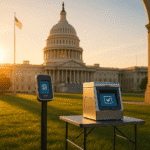
Introduction: A Troubling Intersection of Policy and Profit
Recent market movements have spotlighted a deeply concerning trend: politicians with direct influence over military policy appear to be trading defence stocks at suspiciously opportune moments. With the United States conducting strikes on Iranian targets just days ago, the timing of these trades raises serious ethical questions about insider knowledge and market fairness. This isn’t merely a political issue; it’s a market distortion that could ripple through portfolios with exposure to aerospace and defence sectors. As geopolitical tensions flare, particularly in the Middle East, the intersection of policy decisions and personal profit demands scrutiny from any serious investor. Why does this matter now? Because the defence sector, already buoyed by escalating global uncertainty, could face volatility not just from conflict, but from the perception of rigged games at the highest levels.
The Ethical Quagmire: Policy Makers as Market Players
Let’s dive into the heart of the issue. Members of congressional committees overseeing armed services and defence budgets wield extraordinary insight into potential military actions, procurement contracts, and strategic priorities. When these same individuals trade shares in companies like L3Harris Technologies (NYSE: LHX) or other major defence contractors just before significant geopolitical events, it’s hard to ignore the optics. Reports from financial news outlets, including detailed coverage by Benzinga, highlight specific instances where lawmakers disclosed substantial purchases in the lead-up to recent US-Iran tensions. The implication is stark: are these trades based on public information, or do they reflect privileged access to classified briefings?
This isn’t a new problem. Historical data shows that congressional stock trading often outperforms market benchmarks, with studies from the early 2000s suggesting abnormal returns for portfolios mimicking politicians’ disclosed trades. But in the defence sector, the stakes are uniquely high. A single policy decision, like approving a multi-billion-pound contract for missile systems, can send a contractor’s stock soaring. If those shaping the decision are also positioned to profit, it erodes trust in both governance and market integrity.
Market Implications: Volatility Beyond the Battlefield
First-Order Effects: Defence Sector Sensitivity
Defence stocks are already hypersensitive to geopolitical noise. With Iran reportedly preparing retaliatory actions, as noted in recent online discussions on social platforms, the sector is primed for sharp moves. Companies like Lockheed Martin, Raytheon Technologies, and Northrop Grumman often see price spikes on news of conflict, as investors anticipate increased government spending. But when political trading enters the equation, we’re not just pricing in military outcomes; we’re pricing in the perception of impropriety. A whiff of scandal could trigger sell-offs if public backlash forces regulatory scrutiny or divestment mandates.
Second-Order Risks: Sentiment and Sector Rotation
Beyond immediate price action, consider the second-order effects. If trust in fair markets wanes, institutional investors might rotate away from defence stocks into less politically charged sectors, like utilities or consumer staples. Smaller retail investors, already wary after years of high-profile insider trading cases, could amplify this shift, creating a negative feedback loop for the sector. Moreover, if legislation emerges to curb congressional trading (a long-discussed but seldom-actioned idea), it might introduce new compliance costs or disclosure rules, further weighing on sentiment.
Historical Parallels: Learning from Past Scandals
Recall the fallout from the 2008 financial crisis, when public outrage over perceived insider dealings led to sweeping reforms like Dodd-Frank. While defence isn’t banking, the parallel lies in the erosion of trust. Back then, markets punished sectors seen as ethically compromised, with long-term underperformance in certain sub-indices. Could we see a similar drag on defence if this issue gains traction? It’s not a certainty, but it’s a risk worth modelling.
Forward Guidance: Navigating the Minefield
For investors, the takeaway is clear: monitor defence holdings with a hawk’s eye. Short-term, the sector may benefit from heightened tensions, with budget increases likely if the Middle East situation escalates. But keep a weather eye on political developments. If media pressure mounts, as it did with recent coverage in outlets like Finbold, we could see proposals for stricter trading bans gain momentum. Tactically, consider hedging long positions in defence with puts or diversifying into uncorrelated assets until the ethical storm clouds clear.
As a speculative hypothesis to chew on, what if this controversy sparks a broader re-rating of ESG (Environmental, Social, Governance) scores for defence contractors? If governance concerns tank their ratings, we might see index funds and pensions underweight the sector, creating a buying opportunity for contrarians willing to stomach the headline risk. It’s a bold call, but one worth pondering as we watch this peculiar dance of policy and profit unfold. After all, in markets as in war, timing is everything, and sometimes a well-placed jest about politicians playing both general and gambler is the sharpest commentary of all.