Key Takeaways
- Rocket Lab has reaffirmed its ambitious target for a 2025 maiden launch of the Neutron rocket, a vehicle central to its long-term strategy for competing in the medium-lift market.
- The company’s strategic pivot towards becoming an end-to-end space systems provider, underscored by a major satellite bus contract with the Space Development Agency (SDA), is diversifying revenue and de-risking its reliance on launch programmes.
- Despite persistent GAAP-level unprofitability, the company’s financial position has strengthened considerably, with cash reserves of over $780 million as of early 2024 providing a substantial runway for Neutron’s capital-intensive development.
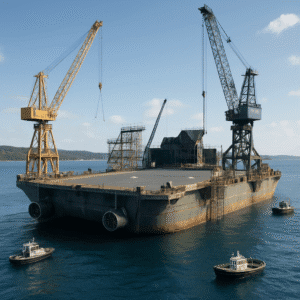
- While Neutron’s timeline remains aggressive, tangible progress, such as securing a shipyard to modify its ocean landing platform, signals that preparations are advancing beyond the drawing board.
- The primary challenge for Rocket Lab is not market competition but execution risk. Delivering Neutron on schedule and on budget is the critical test that will define its valuation and market position for the latter half of the decade.
Rocket Lab’s recent reiteration of its 2025 launch target for the Neutron rocket is more than a simple calendar update; it represents a moment of profound strategic importance for the company and the broader commercial space industry. This commitment, made in its annual shareholder letter, anchors the company’s ambitious transition from a niche small-satellite launcher into a vertically integrated space company aiming for the lucrative medium-lift market. While the timeline is undoubtedly aggressive, focusing solely on the launch date overlooks the more significant evolution happening within the business, particularly its strengthening financial position and the rapid growth of its Space Systems division.
Neutron’s Strategic Imperative
The Neutron rocket is the linchpin of Rocket Lab’s second act. Designed as a reusable, medium-lift vehicle capable of deploying constellations and carrying up to 13,000 kg to low Earth orbit, it is engineered to directly address a burgeoning market segment that sits below the heavy-lift capabilities of SpaceX’s Falcon 9. Its unique carbon composite structure and the innovative “Hungry Hippo” fairing design, which remains attached to the booster, are tailored for rapid reusability and cost efficiency.
Progress has been tangible. The selection of Bollinger Shipyards to modify a large vessel for ocean-based landing and recovery operations demonstrates concrete steps towards realising the reusable architecture.1 Furthermore, ongoing development of the Archimedes rocket engines and the build-out of the Neutron launch site at Wallops Island, Virginia, all point towards a programme that, while challenging, is actively moving forward. However, the aerospace sector is littered with ambitious timelines that have succumbed to the realities of complex engineering. The 2025 target should therefore be viewed as a statement of intent rather than an immovable deadline.
De-risking the Vision with a Strengthened Balance Sheet
Perhaps the most misunderstood aspect of the Rocket Lab narrative is its financial health. The simplistic view of a perennially cash-burning enterprise misses the recent strengthening of its balance sheet and the strategic maturation of its business model. While the company is not yet profitable on a GAAP basis, its financial position provides a significant buffer to fund Neutron’s development.
A review of its recent financial standing reveals a much healthier picture than a year prior. The cash burn required for Neutron is substantial, but it is being managed against a backdrop of growing revenues and a formidable cash reserve.
| Metric | As of Q1 2024 Results | Context |
|---|---|---|
| Revenue (Q1 2024) | $92.8 million | A significant increase year-over-year, driven by both Launch and Space Systems. |
| GAAP Net Loss (Q1 2024) | $(42.8) million | Continued investment in R&D, particularly for Neutron, drives ongoing losses. |
| Cash & Equivalents | $780.8 million | Provides a multi-year runway for capital expenditure without immediate need for further financing. |
Source: Rocket Lab Q1 2024 Earnings Report.2
This financial footing is crucial. It allows the company to pursue the high-risk, high-reward Neutron programme from a position of relative stability, insulated from short-term market volatility or financing pressures.
The Quiet Rise of Space Systems
While Neutron captures the headlines, the growth of Rocket Lab’s Space Systems division is the company’s unsung success story. This segment, which designs and manufactures components like satellite buses, star trackers, and reaction wheels, has become a formidable revenue engine in its own right. The cornerstone of this success is the $515 million contract to design and build 18 satellite buses for the U.S. Space Development Agency (SDA).3
This contract is a watershed moment. It repositions Rocket Lab from being merely a launch service provider to a critical partner in the defence and commercial space supply chain. This diversification provides a valuable hedge against the inherent risks and timelines of the launch business. As this division grows, it generates consistent revenue that helps fund the development of Neutron, creating a virtuous cycle that de-risks the entire enterprise.
Execution in a Crowded Field
Ultimately, Rocket Lab’s future hinges on execution. The competitive landscape is intensifying, with SpaceX’s Falcon 9 dominating the market, ULA’s Vulcan now operational, and Blue Origin’s New Glenn on the horizon. Neutron is not designed to unseat Falcon 9, but to serve the wave of constellation deployments that require a dedicated, responsive, and cost-effective medium-lift vehicle. Its success will depend on delivering that capability on time and on budget.
Any significant delay to the Neutron programme beyond 2025 would likely test investor patience, but the company’s fate is no longer tied exclusively to this single rocket. The robust health of its Space Systems division ensures it has the strategic depth to weather potential setbacks. For investors, the calculus has shifted. Rocket Lab is no longer a speculative bet on a single launch vehicle but an investment in an integrated space company with multiple, complementary lines of business. The speculative hypothesis to consider is not whether Rocket Lab might be acquired, but what happens if it succeeds: a successful Neutron flight could validate the business model for integrated, non-legacy space companies, potentially triggering a wave of consolidation among less efficient players who can neither build nor launch their own hardware effectively.
—
References
1. Rocket Lab. (2024, June 10). Rocket Lab Selects Bollinger Shipyards to Support Modification of Neutron Landing Platform. Retrieved from https://www.businesswire.com/news/home/20240610996884/en/Rocket-Lab-Selects-Bollinger-Shipyards-to-Support-Modification-of-Neutron-Landing-Platform
2. Rocket Lab. (2024, May 6). Rocket Lab Announces First Quarter 2024 Financial Results. Retrieved from https://investors.rocketlabusa.com/news/news-details/2024/Rocket-Lab-Announces-First-Quarter-2024-Financial-Results/default.aspx
3. U.S. Department of Defense. (2023, January 9). SDA Announces Agreement with Rocket Lab for 18 Satellites. Retrieved from the Space Development Agency’s official announcements or related press coverage.
4. @StockSavvyShay. (2024, July 11). [$RKLB REAFFIRMS 2025 NEUTRON LAUNCH TARGET IN ANNUAL SHAREHOLDER LETTER RELEASED AFTER HOURS]. Retrieved from https://x.com/StockSavvyShay/status/1811529367493726487