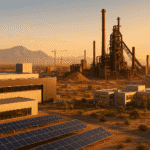
- Opposition to wind and solar projects in the US is escalating, particularly in rural areas concerned with land use and agricultural disruption.
- New federal regulations have introduced restrictions on renewable installations, potentially delaying or cancelling major projects.
- Investor confidence may waver as subsidies are reduced and project timelines extend, threatening valuation multiples and clean energy targets.
- Global parallels, such as in the UK and Taiwan, suggest a broader trend of tension between renewable development and local opposition.
- Hybrid energy models and offshore alternatives may offer mitigation strategies as the sector recalibrates to policy risks.
Recent shifts in US energy policy have cast a shadow over the renewable sector, with growing opposition to wind and solar projects that encroach on agricultural lands. This resistance, rooted in concerns over land use and economic impacts on farmers, could reshape investment landscapes and slow the transition to clean energy. As policymakers prioritise traditional energy sources and rural economies, the renewable industry faces heightened regulatory hurdles, potentially diverting capital towards more stable sectors.
Policy Headwinds for Renewables
The pushback against large-scale wind and solar installations in the United States has intensified, particularly where these projects intersect with farmland. Critics argue that such developments disrupt agricultural operations, reduce productive land, and impose long-term economic burdens on rural communities. For instance, solar farms often require vast tracts of land, which can lead to soil compaction and altered water flows, while wind turbines are blamed for noise pollution and visual blight that affect livestock and crop yields.
According to reports from The New York Times dated 7 August 2025, federal agencies have introduced restrictions that could halt the construction of solar and wind farms on both public and private lands. This aligns with broader policy directives aimed at scrutinising renewable projects more rigorously, potentially delaying approvals and increasing costs for developers.
In California, as noted in a CalMatters article from 14 July 2025, clean-energy initiatives are encountering new federal hurdles, including deadlines for tax credits and limits on foreign components. This has put eleven solar projects and one onshore wind project at risk of delays or cancellation, underscoring how policy changes can cascade through the sector.
Impact on Agricultural Communities
Farmers have emerged as vocal opponents, viewing these projects as threats to their livelihoods. Wind farms, with their towering structures, can interfere with aerial crop dusting and create microclimates that affect harvests. Solar arrays, meanwhile, convert arable land into energy production sites, often under long-term leases that lock out traditional farming for decades.
A Forbes article from 30 November 2022 highlighted how fossil-fuel funded opposition groups are leveraging misinformation to block clean energy transitions, a tactic that continues to gain traction. More recently, an NPR piece from 28 March 2022 discussed how misinformation about renewables is leading to local restrictions, a trend that persists into 2025 as communities push back against perceived encroachments.
In the UK context, a piece from The Hill, published five days prior to 20 August 2025, described how opposition to solar and wind projects is derailing net-zero ambitions, with rural landowners resisting developments on aesthetic and practical grounds. This international parallel suggests that the US challenges are part of a global pattern where renewable expansion clashes with local interests.
Economic Ramifications for Investors
For investors, this policy opposition translates into uncertainty for renewable energy stocks and funds. The sector has historically benefited from subsidies and tax incentives, but with potential rollbacks, project pipelines could shrink. Analyst models from BloombergNEF, as referenced in an X post analysis from 15 August 2025, project a 41% plunge in US annual clean energy installations after 2027 due to phasing out of wind and solar tax credits.
Sentiment from credible sources like the State Policy Network, in a 6 March 2024 report, identifies blocking renewable energy as a top legislative priority, favouring fossil fuels. This could lead to higher utility bills and lost tax revenues, as per an EDF analysis dated 19 August 2025, which charts significant economic losses from policies hindering wind buildouts.
- Job creation in renewables, which reached over 3 million globally in 2023 per historical IRENA data, may stall in the US if projects are curtailed.
- Valuation multiples for solar and wind companies could compress, with forward P/E ratios potentially dropping below historical averages of 20-25x seen in 2020–2022.
- Diversification into hybrid energy models, combining renewables with storage or gas backups, might offer resilience against policy risks.
Forecasts from analyst-led models, such as those by Energy Innovation in their 2022 assessments, suggest that permitting reforms could mitigate some opposition by streamlining approvals, but without such changes, renewable growth might average only 5–7% annually through 2030, compared to 15% in supportive policy environments.
Global Comparisons and Lessons
Taiwan’s renewable energy challenges, detailed in a PVknowhow.com article from 27 March 2025, mirror US issues with delays in wind and solar projects due to policy shifts and local opposition. Similarly, a Politico report from 17 July 2025 reveals US Interior Department directives requiring high-level sign-offs for renewables, adding bureaucratic layers that critics label a ‘shadow ban’ on clean energy.
An E&E News article from approximately one month before 20 August 2025 echoes concerns over added red tape at the Interior Department, potentially bottlenecking projects. Environmental Science Associates, in a July 2025 piece, warns that new policies will create delays for solar and wind developments, ending preferential treatment for these sources.
Strategic Implications for the Sector
As opposition mounts, renewable firms may pivot towards offshore wind or urban solar installations to minimise land conflicts. However, offshore projects face their own hurdles, including higher costs and environmental reviews. Investors should monitor legislative developments, such as potential reforms to the Contracts for Difference auctions in the UK, where subsidy cuts could render wind and solar uneconomic, as noted in an X post from Net Zero Watch on 12 February 2025.
Dry humour aside, it’s ironic that technologies hailed for sustainability are now accused of ‘destroying’ the very landscapes they aim to preserve. Yet, this tension highlights a critical investment thesis: renewables must balance environmental goals with economic realities to thrive.
In summary, policy opposition to wind and solar projects, especially those impacting farmers, poses significant risks to the sector’s growth trajectory. While historical trends show renewables contributing 10% to US electricity in 2024 per EDF data, future expansions hinge on navigating these headwinds. Investors would do well to assess portfolios for exposure to policy-sensitive assets, potentially reallocating towards more insulated energy plays.
References
- CalMatters. (2025, July 14). California wind and solar projects face new federal hurdles. https://calmatters.org/environment/2025/07/california-wind-solar-projects-face-new-federal-hurdles/
- EDF. (2025, August 19). Economic analysis of policy impacts on wind expansion. https://x.com/edf
- Energy Innovation. (2022). Permitting reform analysis. https://www.sciencedirect.com/science/article/pii/S0301421522001471
- Environmental Science Associates. (2025, July). New policy will create bottlenecks for solar and wind projects. https://esassoc.com/news-and-ideas/2025/07/new-policy-will-create-bottlenecks-for-solar-and-wind-projects
- Forbes. (2022, November 30). Fossil-fuel funded opposition is blocking America’s clean energy transition—permitting reform can help. https://www.forbes.com/sites/energyinnovation/2022/11/30/fossil-fuel-funded-opposition-is-blocking-americas-clean-energy-transition-permitting-reform-can-help/
- NPR. (2022, March 28). Renewable energy misinformation driving local opposition. https://www.npr.org/2022/03/28/1086790531/renewable-energy-projects-wind-energy-solar-energy-climate-change-misinformation
- New York Times. (2025, August 7). Trump’s policy shift threatens solar and wind permits. https://www.nytimes.com/2025/08/07/climate/trump-wind-solar-power-projects.html
- Politico. (2025, July 16). Interior Department requires sign-off for clean energy projects. https://www.politico.com/news/2025/07/16/interior-requires-burgum-sign-off-for-solar-wind-projects-00458999
- PVknowhow. (2025, March 27). Taiwan renewable energy challenges: 2025 targets. https://www.pvknowhow.com/news/taiwan-renewable-energy-challenges-2025-targets/
- The Hill. (2025, August 15). Britain’s net-zero scheme faces resistance from rural landowners. https://thehill.com/opinion/energy-environment/5451813-britains-net-zero-scheme-is-being-derailed-by-opposition-to-solar-and-wind-projects/
- E&E News. (2025, July). Interior’s new solar and wind policy sparks concerns of shadow ban. https://www.eenews.net/articles/interiors-new-solar-wind-policy-sparks-concerns-of-shadow-ban-2/
- Energy and Policy Institute. (2024, March 6). State Policy Network’s strategic opposition to renewables. https://energyandpolicy.org/state-policy-network-anti-wind-solar-power/
- X (formerly Twitter): Michael Shellenberger. (2023). https://x.com/shellenberger/status/1617694152220872705
- X: Evaristus Odinikaeze. (2025). https://x.com/odinikaeze/status/1939475696050458898
- X: Net Zero Watch. (2025, February 12). https://x.com/NetZeroWatch/status/1889723197806789039